Generate complementary value with AI
Especially if you don't have to develop and train those models yourself anymore and it becomes cheaper each year!

Hello to nine new subscribers since the last article - I’m happy and thankful to have you here! If you have any questions or would like to chat about anything you found interesting this week, please reach out by replying to this mail or commenting below 👇.
App find of the week
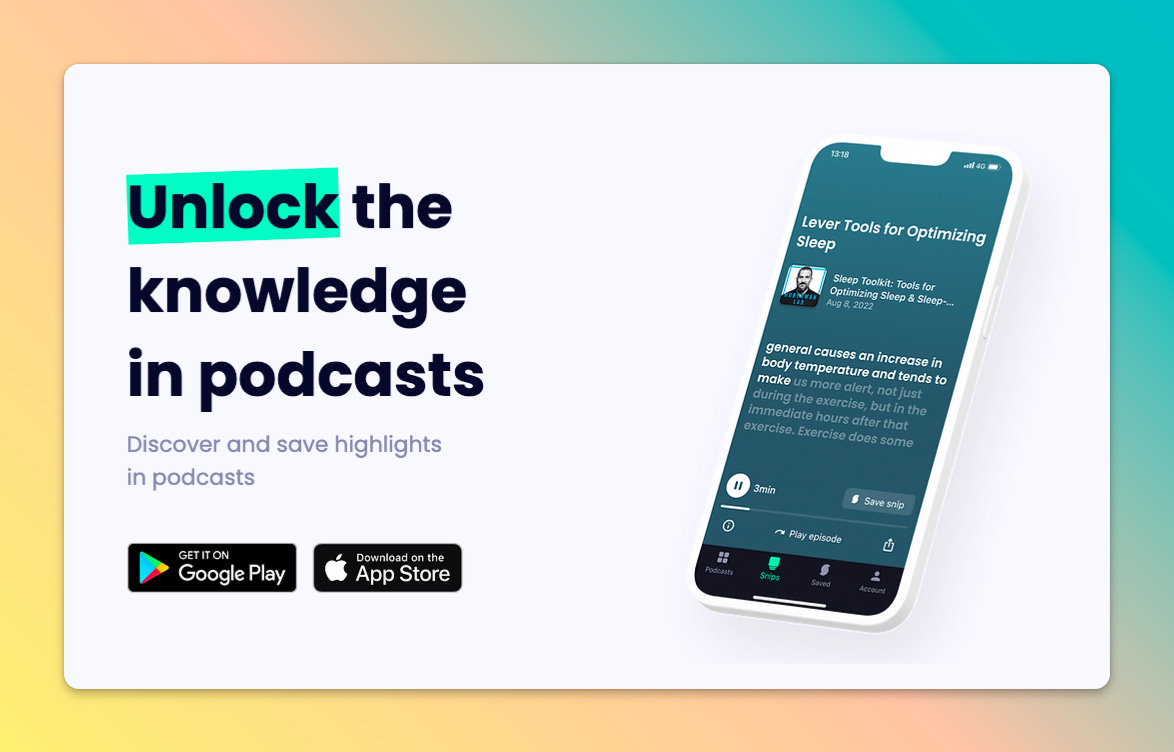
This episode is about a cool new app I found the other day - one that actually became part of the core few apps I use every day (and that doesn’t happen too often): snipd (snipd.com) 🤩.
I only started regularly listening to podcasts a few months ago and just used Spotify for it. It’s great for “just listening” but as you can see in my recent article about Lenny’s Podcast episode with Elena Verna, once you want to go deeper into a podcast, e.g. for sharing certain parts, it gets tricky. The only thing that Spotify supports is a timestamped URL but that is in seconds and somehow didn’t really work from mobile the way I wanted. For the article, I probably listened to the podcast 3 times to get the transcribed parts right.
I haven’t tried any other dedicated podcast app/ player but I’d say snipd is not just any player. At its core, the app lets you create and store collections of snips, their phrase for custom highlights. Highlights are simple, they have a start timestamp and an end timestamp and maybe a description and I would guess other podcast apps have the same functionality. But what I like most about snipd is that they don’t stop there. With a range of features, they show how simple it is to generate additional user value for a given context or content as access to Artificial Intelligence models becomes easier and cheaper every year. Let me explain.
AI step 1: transcription
It probably all starts with the transcription of the podcast episode you’re listening to. From there, the content is already more structured as every word, again, has a start and end timestamp. Also, the text is now easier to process for machines.
AI step 2: chapters titles and descriptions
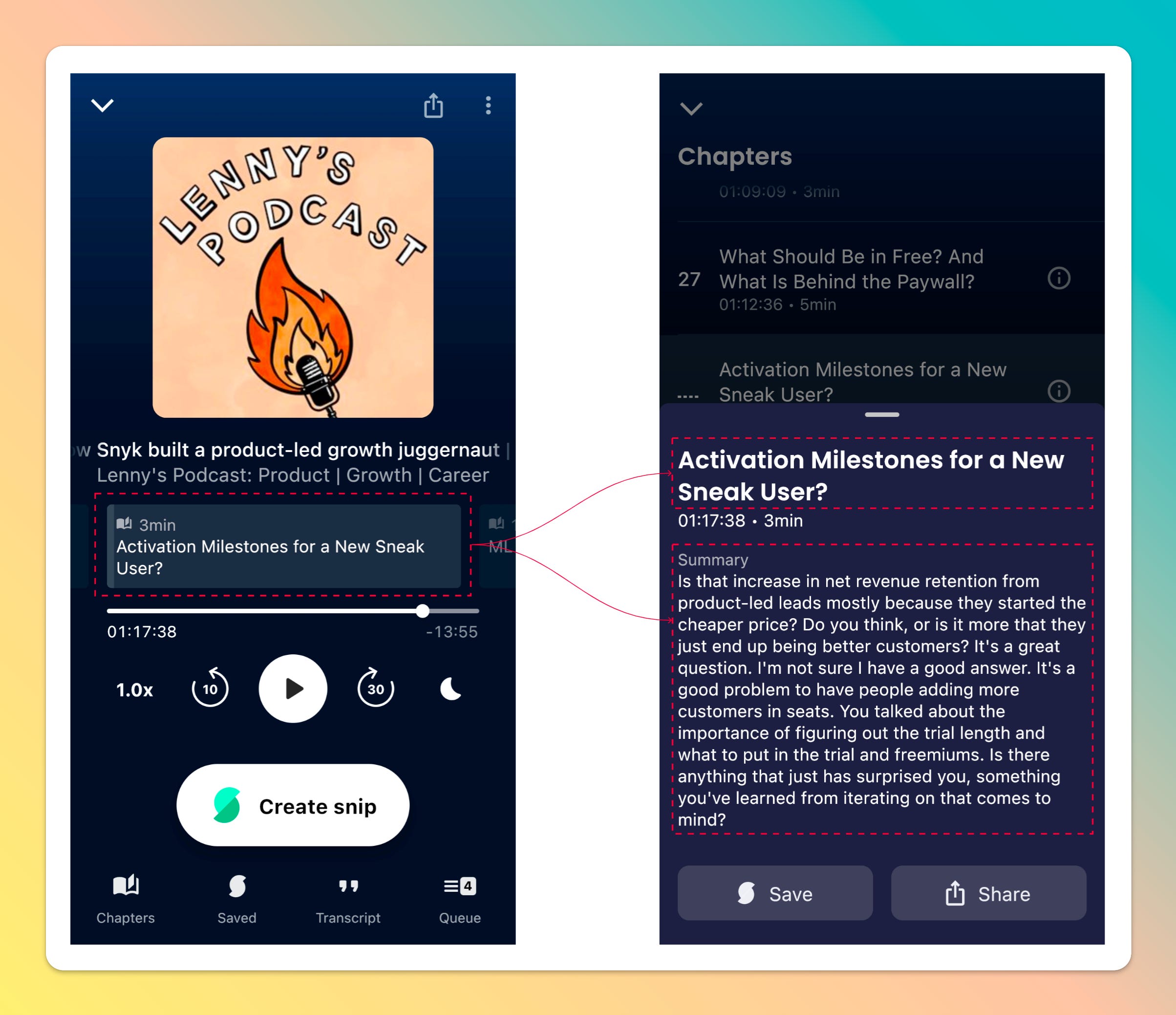
And this is where the magic starts: snipd automatically breaks the episode up into chapters, gives them titles and writes up a summary. This lets me browse through the episode a lot faster.
AI step 3: title recommendation
I can also create and store my own “snips” from and to a timestamp of my choosing. I should give this snip an expressive title now - you know - to find it again easily. But coming up with expressive titles is somewhat difficult and might make some users dismiss their perfectly curated podcast highlight. But don’t worry, the app’s got you: how about one of those suggested titles? 🤗
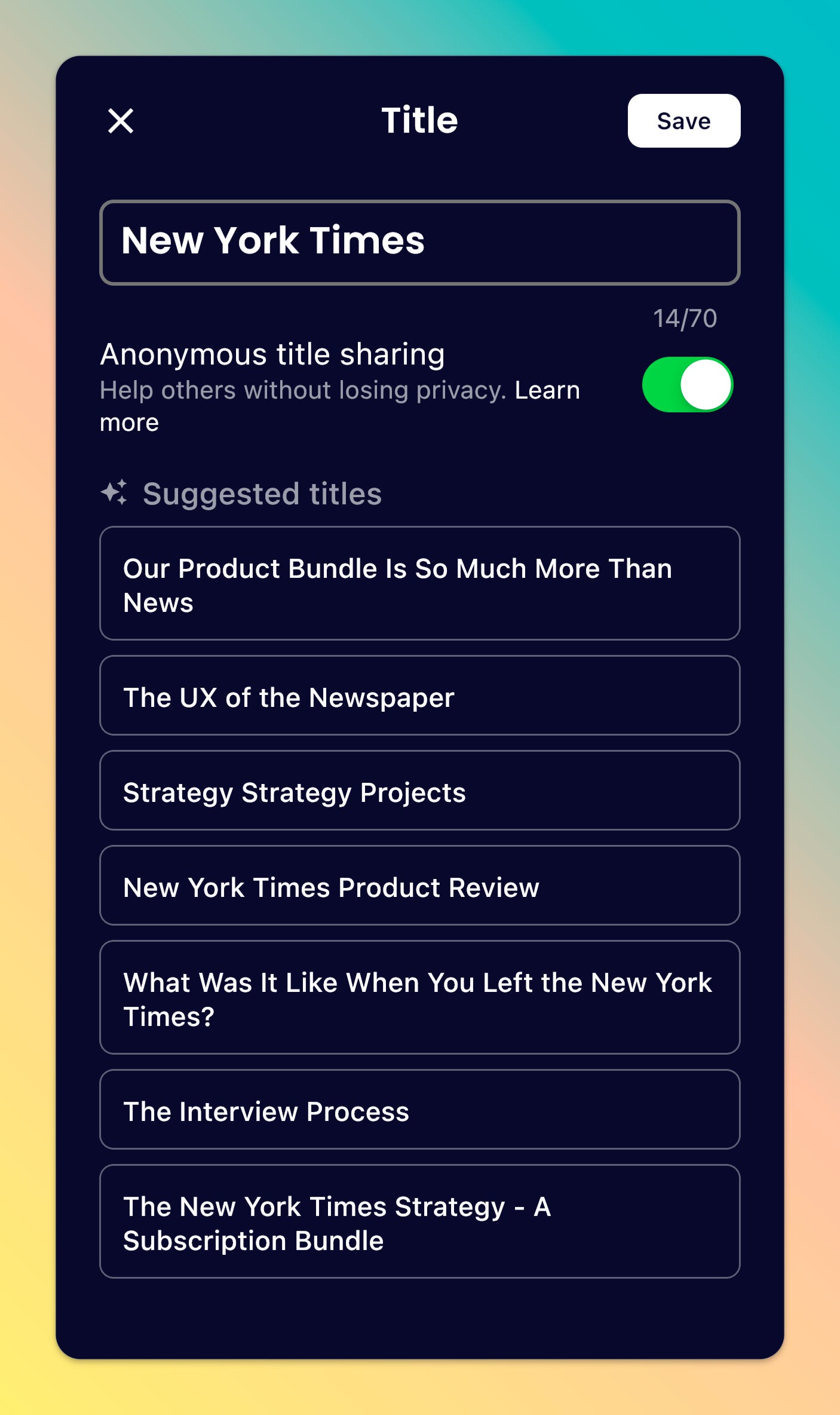
First, this seems random. But from my point of view, it’s such a well-thought-through feature. Even if just a really low portion of users are frightened to express themselves in a title, the app offers you support. Unsurprisingly, given creating snips is one of the core activation actions they want you to accomplish. As you grow your collection of snips you want to find again, you get hooked on the application.
Accessibility of AI as a Service
And indeed, it seems like to provide these features, you simply do not need to invest in costly infrastructure and highly-skilled engineers to develop and train your models anymore. My year’s highlight so far was when I got my hands on the open beta for GPT-3 (beta.openai.com/playground) with all its different example use cases ranging from paragraph summaries for a two-year-old over predicting code blocks (I mentioned GitHub’s GPT-3 powered Copilot in this article) to a fairy tale bedtime story - but please with a funny twist.

And just yesterday, one of our Machine Learning engineers did a Lunch and Learn where he showcased how text-processing AI models evolve over time. As small startups won’t be able to catch up with the massive models such as GPT-3 anymore, his role might change to a prompt engineer, tweaking the way you ask these transformer models the right question to get the best possible answer. Truly standing on the shoulders of giants.
What are the legal limits for processing this content?
I am wondering where the legal limits are for this. At Building Radar, part of our product is analyzing newspaper articles on whether they are about a construction project or not (and if so, a construction project when, where, and with whom etc.). Once we found out it is a construction project of the type our clients are looking for, we send the project to their in-app inbox. However, due to copyright law, we seem to not be allowed to show the full text to our users, even if we would reference the original source. For snipd, it’s the same case: the content (podcast) is publicly available and they run additional services or features on top of it. In fact, many podcasts provide transcripts of their episodes on their website. Are you allowed to use others’ content like this?
Nevertheless, this was really interesting to me. Without holding back on potential copyright difficulties and leveraging cheap and accessible AI services, snipd is able to provide additional user value to me as a consumer and draw me into their app. And if I had a podcast myself, I would be happy for my listeners to get more out of my content. Find me while exploring similar podcasts. Find relevant parts faster. Store highlights in a simpler way. Share them in a cooler way.
Happy for your feedback!
In my That Was Interesting series I want to showcase content and product approaches that I find on the go and think are worth sharing. What do you think of GPT-3? Have you tried out the playground yet? How is my writing? Please let me know in a comment.
The same night I released this article I found out Canva recently released an "image imagination" beta. The next day I got invited to join the private Alpha for Notion's "Notion AI" 😱.
Seeing major digital tools such as Notion and Canva - two products I love - directly embed AI tools support shows that we are at the beginning of a race. I assume that all those services run on OpenAI's GPT-3 API.
Which product will have figured out the best use cases first? How much of a competitive advantage is this given that access to the same model is unlimited? Is the new AI skillset really "prompt engineering"? What a time to be alive.
Notion AI: https://youtu.be/FElBbgnNtVA 🤖
Canva text to image: https://www.canva.com/newsroom/news/text-to-image-ai-image-generator/ 🖼️